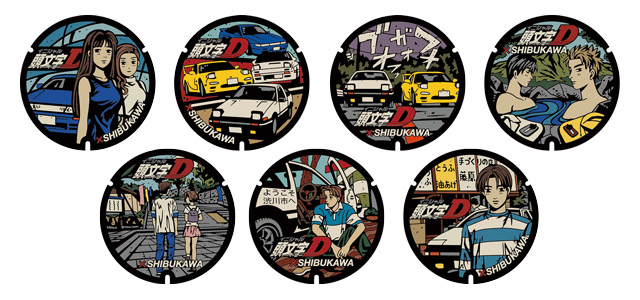
What’s most notable about Japanese manhole covers may not be their intricate designs, bright colors, or tie-ins to popular franchises like Pokémon or Gundam. What really boggles the mind is how Japan is able to manufacture seemingly one-off examples of heavy iron cast discs, like the Initial D-themed covers in Shibukawa City, in a manner that doesn’t break municipal budgets.
Japan’s customized manhole covers have transformed a mundane utility requirement into a national pastime. Over 95 percent of Japan’s nearly 1,800 municipalities boast their own distinct cast-iron lids. Hobbyists who call themselves manholers or drainspotters will travel out of their way to observe specific manhole covers and check them off a list like birdwatchers.
The manufacturing process of custom manhole covers is captured in the video above by Process X, which takes viewers inside the foundry of Hinode Water Equipment Co., Ltd., founded in 1919. Raw scrap steel is melted down in furnaces and poured directly into sand molds. Once the metal solidifies, the sand mold is broken away to release the casting.
After shot blasting, hand finishing and electrodeposition for corrosion resistance, workers pour colored resins or acrylic paints into the recessed pockets created by the raised cast iron outlines for that stained glass-on-metal look. The ridges created by the artwork in theory provide grip and slip resistance for pedestrians and tires on rainy days.
Each sand mold is created by a master pattern. In the old days, these would be carved out of wood but modern CAD modeling and CNC milling has made the creation of elaborate, one-off patterns far easier. Each master pattern can be used thousands of times.
However, elaborate designs like the Initial D covers in Shibukawa City are typically used in just one location. Their uniqueness is what drives manholers to visit the town and go on scavenger hunts to “collect ’em all”. As such, the city may order a single-digit run, and only because they may need spares in case the one in use becomes worn or damaged.
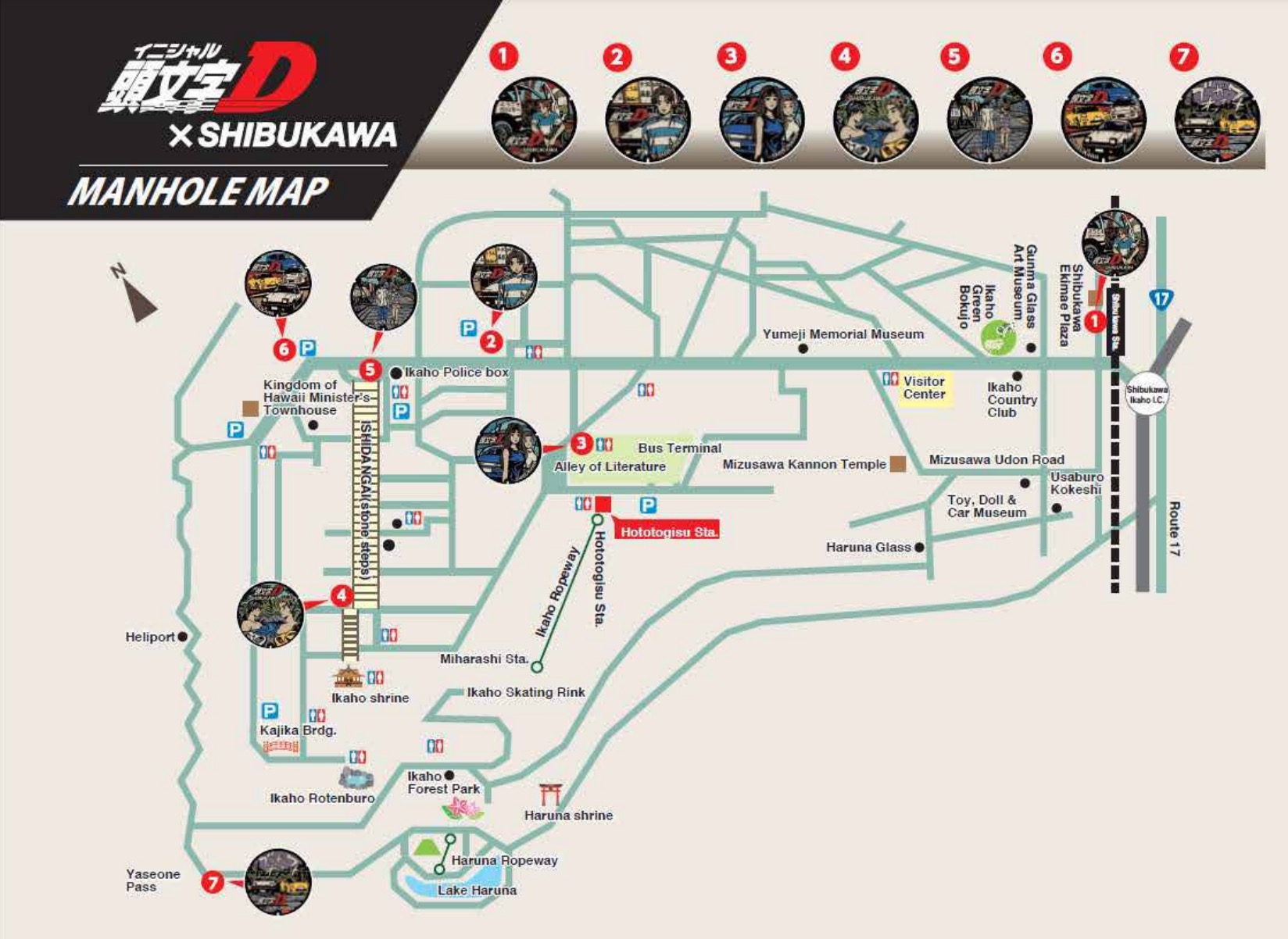
In Shibukawa, Gunma Prefecture, the real-life setting of Initial D, the covers are placed near sites corresponding to scenes from the manga and anime. For example, the cover of Takumi and Natsuki is located at the base of the 365-step stone staircase where the two go on a date. The cover of Takumi’s AE86 and the Takahashi brothers’ Mazdas is set near the old toll gate that serves as the starting line for the battle on Mount Akina (Mount Haruna in real life).


The cost of a custom cover with color artwork can cost six to twelve times as much as a regular iron cover. So how does a local government afford them? For one, in many cases the IP owner waives the licensing fees required to depict their characters and logos, viewing it as free marketing. The Sewerage Public Relations Platform of Japan (GKP), alongside local municipalities, offer promotion as well, including free physical collectible manhole cards. Then there’s the merch, which uses the existing artwork on magnets, buttons, coasters, keychains, and so on. And finally, there’s the tourism angle, as the manhole covers serve as an attraction that draws in visitors who will boost the local economy.
For the foundry itself, companies like Hinode Water Equipment rely on high-volume automated sand casting for standard municipal orders, which subsidizes the operational infrastructure needed to execute small-batch custom runs.
It’s a delicate balance between governments, foundries, media companies, tourism bureaus, and artists. Each party must contribute in its own way without getting too greedy, and in the end it all somehow works to create an ecosystem and subculture that didn’t exist before.
Images: Shibukawa City