


Japanese Nostalgic Car was launched 20 years ago in what felt like a vastly different world. In October 2006 you could walk into a dealership and buy a brand new Honda S2000 or Mitsubishi Lancer Evo IX off the lot, cars like the Toyota AE86 and Z31 Nissan 300ZX had not yet hit the 25-year threshold to become historic vehicles, builds like the one above were common, and names like Hakosuka and Kenmeri were still largely unknown in the US. JNC was built to champion the overlooked Japanese classics and celebrate the rich heritage of Japan’s automotive golden eras. It’s been an uphill battle at times, but things have evolved considerably.
How has the landscape for Japanese cars changed in the last 20 years?
The most entertaining comment by next week will receive a prize. Scroll down to see the winner of last week’s QotW, “Which JNC is most emblematic of the 1960s?“
It is of course impossible to narrow 1960s Japan to just one car. It was a time of incredible change that saw utilitarian conveyances evolve into dream cars like the Toyota 2000GT, as nominated by dankan and Negishi no Keibajo, in just a few short years. Before the end of the decade incredible race cars like streetspirit‘s Prince R380 came to fruition. Of course, we can’t forget the common cars that moved people like the 410 Datsun Bluebird suggested by Kyuusha Corner, or which acted as ambassadors for Japanese products like the barikan Corona chosen by Dutch 1960.
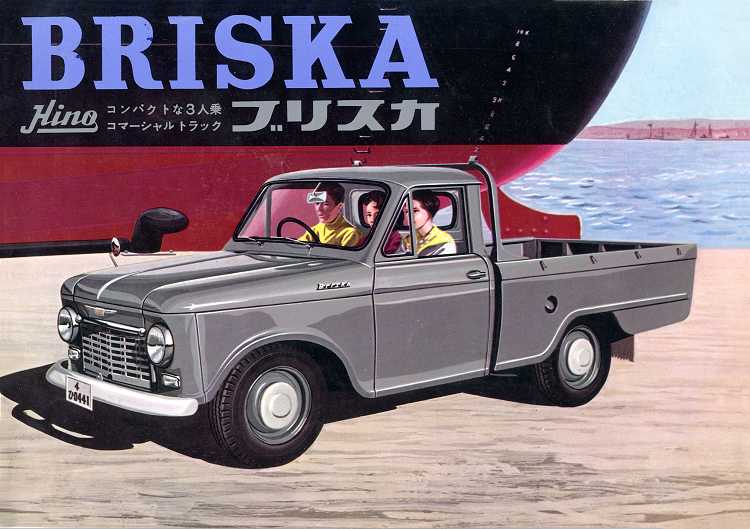
All are worthy, but we could only crown one champion and this week the winner is Nihonnotekko, whose ode to a little loved workhorse emerged victorious:
Ahhh, the height of the Miracle Economy…Well you know, there’s somethin’ funny about economic miracles: They don’t build themselves out of thin air. There’s a lot of hard work, sweat, tears, blood…and pickup trucks.
Humbly thrumming along in industrial and agricultural areas across Japan, the Hino Briska was one of a cadre of pickups that propelled the Miracle. Haulin’ the small stuff is what makes building the big stuff possible, and that’s true anywhere you go. It may not have been the flashy star of the show like them fancy 2000GTs and Cosmos that came preening after most of the reeeal hard work was done; A Briska in ’64 wouldn’t have turned a head…But the 60’s were a decade of doin’ stuff, and partner…back then, you did that stuff with a Briska…
The most emblematic isn’t always the halo car on the poster. So I say let’s lavish some praise on one of the workin’ trucks that built the nation that built those halo cars: Hino Briska
Omedetou, your comment has earned you a set of decals from the JNC Shop!


For better and for worse. There’s no doubt (some) Japanese cars have finally gotten the respect they deserve in the US, yet they’re less attainable than ever. A lot of people who may have become interested in them in the first place because of their affordability compared to European or American classic cars have been priced out entirely.
The landscape has gotten wider. The portrait has gotten taller.
My dad and I were at the local Honda dealer during the summer. He had wanted to check out the HRV and CRV. No shortage of those vehicles on the dealer lot. Same went for the Pilot, Passport, and there was a Prologue as well. Accord and Civic inventory were thin, with a Civic Type R and new Prelude in the showroom. I don’t remember seeing any Odysseys either.
I guess, to answer the question, the Japanese car offering here in The States is pretty bland. Yes, there’s the Z, the GR Corolla, the Civic Type R, the Integra Type S, the BRZ, the Miata, final Supra, but that’s it! As a result, even old 1995 Camry V6 XLE or 1993 Accord SE or 1994 Maxima SE bring back to much nostalgia. Old pop-up headlight Preludes and Eclipse GSX are uber rare sights, and their manufacturers have tried to resurrect them with today’s designs, albeit completely different and morphed into something else.
I think in today’s world, everyone’s in it for the money; I mean why else do you have a business? And since it’s the SUV that sells, sedans, coupes, sports cars, and station wagons will take a back seat. These are all pretty forgettable years to be honest.
Now the hills have grown steeper than most wallets can carry we pick the flowers in the valley.
20 years ago i mowed lawns, did chores and saved my birthday money to buy a Kyosho 1/18 model of an rx-7.
10 years ago i browsed used car sites for a ta22 or 280zx that was just outside my grasp.
Today i’m chasing a nissan prairie, dreaming (and collecting parts) of a kaido racer build of my own and see loads of charm in the less halo-status JNC.
I had to take some time to reflect—from this side of the world—on how the landscape for Japanese cars and brands has shifted over the last 20 years. While they are highly regarded, there are some stark contrasts. Toyota, for its part, is a solid bet; the “exciting” side of the brand is represented by the Hilux and its GR (Gazoo Racing) variants. The 86 was a modest wake-up call, and the GR Yaris is the real standout. Honda maintains a somewhat snobbish, “superior” attitude (and its—admittedly few—customers seem to justify the premium). As for Nissan… just a week ago, the brand shifted to a new importer; they’ve been remarkably erratic, and there’s nothing particularly exciting in their current lineup. Since the Lancer, Mitsubishi’s only real offering is the L200/Triton, and even that arrives only in dribs and drabs. We don’t have Mazda or Daihatsu here; Subaru and Suzuki are the exceptions—though their offerings are also limited, they’ve stayed true to their core identity and have retained a very loyal following. There’s no “Swift Sport” these days, but the current version—while tame—still manages to capture a bit of that original spirit. Subaru leans into its classic strengths and is highly valued; in some parts of the country, the brand is practically in its own “Disneyland,” as the local conditions make its vehicles a perfect fit. (Incidentally, these same regions are also a “forgotten paradise” for the Renault 12 and 18—cars that are, in essence, rally machines in street-legal clothing.)
I suppose, then, that the Toyota GR Yaris and the GR Hilux are—perhaps unintentionally—the most exciting offerings from any Japanese brand. And as an added bonus, the Hilux is actually manufactured right here in the country.
It has gotten significantly worse. What car is actually lust-worthy? What car will become as legendary as the cars of the 20 years prior to the last 20? The only car in the last 20 years that I feel isn’t depressingly bad is the Honda Fit (I haven’t driven a newer Miata, though). The last 20 years has been a depressing downward spiral where cars are getting worse and worse due to manufacturers not innovating around the (frankly anti-consumer, anti-driver) regulations, and everyone trying to build cars around, and compete on, features and tech. Car reviewers rarely shine a light on this problem as they tend to compare current cars among each other. They never compare them with the greats of the past to see if there has been improvement. It’s usually “these 1 or 2 models are the best drivers cars on the market for reasons because they have the best steering feel, best engine, etc.” But, what about the cars that came before? Why is the steering feel worse, and why do we accept that? Why are the engines not as engaging and why do we not call it out?
With the current trajectory in the landscape for Japanese cars, there isn’t a single car I could bring myself to spend money on – and not a single car that stirs the soul, so I don’t anticipate ever buying a new car. If I started a car company, I would want to make cars where we ask questions such as: Does it eagerly dance with it’s driver? How does it feel to interact with the switches and dials? Does it communicate everything to the driver in a way that delights? How few are the pain points when maintaining or repairing it?