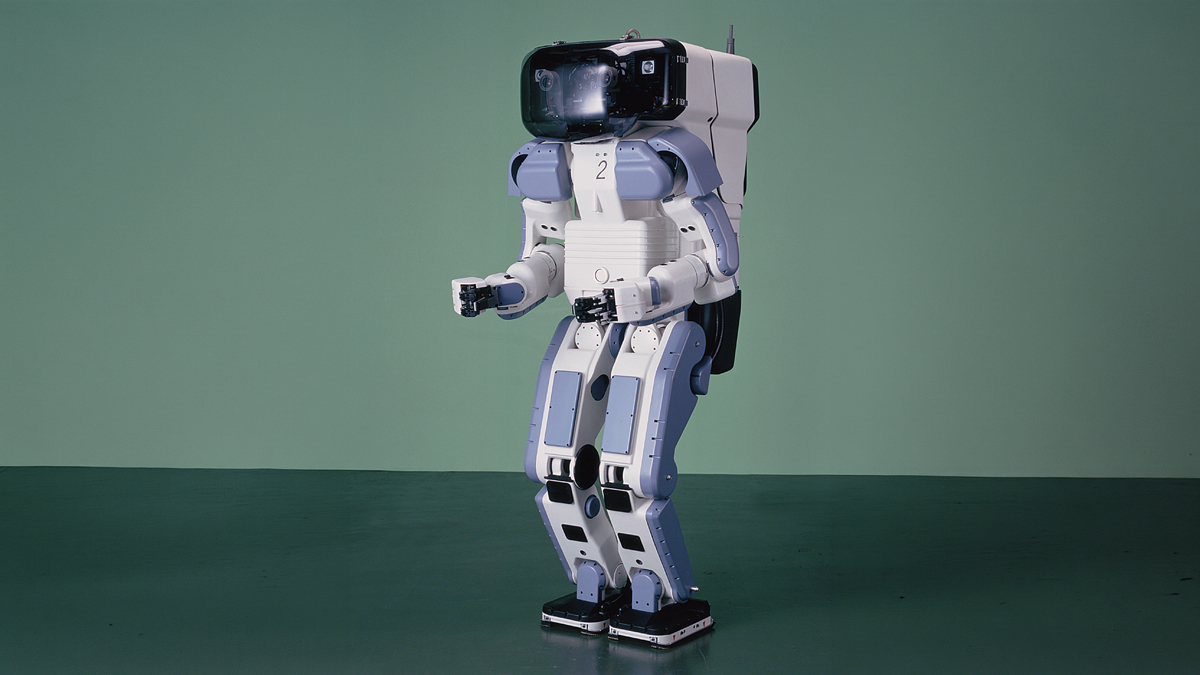
The international Institute of Electrical and Electronics Engineers has recognized the Honda P2 robot as an IEEE Milestone. Introduced in 1996, the P2 was a revolutionary step in the field of robotics, the first self-contained humanoid robot capable of balanced bipedal walking. No one at the time had expected Honda, the maker of practical cars like the Civic and Accord, to leapfrog the world’s premier robotics labs. There was even a term coined for the P2’s introduction: The Honda Shock.
Prior to the Honda P2, robots were “static” walkers, maintaining their balance by simply keeping its center of mass within the support polygon formed by its feet. This resulted in a mechanical-looking gait, in which motion could be paused at any moment in the step without the robot falling down. It’s also not how humans walk at all. We are “dynamic” walkers, constantly shifting our weight to balance, using momentum and gravity to move with flexibility and speed.
While Waseda University’s WL-10RD of 1984 was considered the first bipedal dynamic walker, it could only walk on completely flat surfaces. It was also just two legs tethered by a bunch of cables and not a self-contained unit.
For what it’s worth, Honda also developed its own set of static walking legs, the E0 in 1986. However, the robotics lab was still a pet project within Honda, a secret hidden from the public and most other Honda employees. Outwardly, Honda seemingly had plenty of ambitious projects to keep itself busy, like launching Acura and the start of its epic era of Formula 1 dominance.
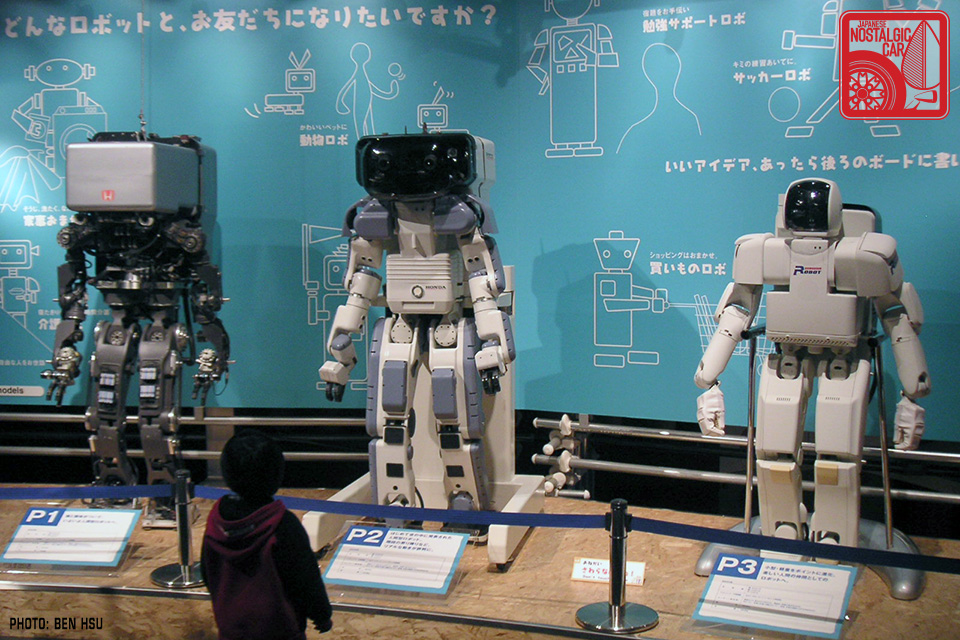
Deep within the lab, Honda slowly evolved the E0. Around the time the Honda Accord became the best-selling car in the US and the NSX debuted, the 1989 E2 became Honda’s first dynamic walking robot. It was still tethered and still just a pair of legs, but achieved a significant breakthrough. In 1993 the final form of the legs-only E series, the E6, could climb stairs and step over objects in its way.
That same year Honda began research on a new series of humanoid robots, starting with the P1. The P-series were starting to look more human, with both arms and legs, though the P1 was limited by a harness connecting to an external power supply.
Honda didn’t go public with its robotics program until December 1996 when it stunned the world with the introduction of the P2. Not only was it standalone (no tether), could walk on uneven surfaces, climb stairs, and ascend slopes all while balancing its limbs in real time.
The P2 could also push a cart at a constant speed and know when to stop if the cart hit an obstruction. Its “master arm” function allowed a remote operator to control its arm for more delicate operations like turning a wrench to tighten a nut, with the P2 providing force feedback for the operator.
The IEEE Milestone recognition is no small matter. A technology can only receive it if it’s over 25 years old. This ensures that the invention has had a lasting impact and avoids hype-based awards. Additionally, it’s not enough for the technology to be novel or profitable; it must be a net benefit to humanity.
The only other major automaker to have won such an award is Toyota, recognized in 2024 for the original Prius. Honda has previously w0n for the 1981 Honda Electro Gyrocator, a primitive real-time map location system that is considered a predecessor to modern GPS. And while not directly car-related, the 1964 Shinkansen bullet train is also a Milestone winner.
The Japanese robotics community coined the term Honda Shock to describe the revolutionary leap that the P2 represented. Robots were no longer relegated to mechanical arms on a factory floor. At the time, it was thought that a standalone humanoid robot was still decades away. The fact that such a machine had been developed in total isolation, by a car company no less, forced leading robotics labs such as MIT and Carnegie-Mellon to rethink their approaches. Honda’s Zero Moment Point framework for balance became the industry standard for decades to come. The humble maker of the Civic had proved that a humanoid robot, long the dream of sci-fi stories, was possible in the real world.