As we round out the year let’s reflect on one of the biggest milestones of 2025. This one has nothing to do with the founding of a company or the debut of a model. This year was the 20th anniversary of the Japanese Classic Car Show, an event that has completely changed how the world views automobiles from Japan. It’s almost hard to remember what the landscape was like 20 years ago, but it wasn’t great for J-tin.
Here’s a list of cars that were killed in 2005 or a few years prior: the Toyota Celica, MR2, and Supra, Honda Prelude and NSX, Mazda RX-7, Nissan Silvia and Skyline GT-R. Cars like the AE86 or NA Miata hadn’t even reached the age threshold to qualify for historic plates yet. People were destroying S13s en masse in the hopes of becoming the next Drift King. Cars we’d cherish today were cheap and plentiful.
The cutoff for true collectors’ cars — those made 25 years or before — was 1980. That essentially meant only chrome-bumpered cars would qualify for historic plates or classic car insurance. Prior to the global financial crisis muscle cars values were still climbing, and cable TV car shows like Horsepower TV and My Classic Car revovled almost exclusively around American cars. That was the focus of auctions like Barrett-Jackson as well, and around that time one of their announcers proclaimed, “You’ll never see a Honda Civic up here.”
But in 2006, a husband and wife team in southern California would quietly organize the first Japanese Classic Car Show. Koji and Terry Yamaguchi, who had immigrated to Los Angeles from Japan, had been involved in the Toyota Owners and Restorers Club, which had been established in 1995. The club held an annual gathering of members, which became a full-fledged car show called Toyotafest.
The Yamaguchis were a big part of Toyotafest, and in 2006 expanded that concept to include all Japanese makes. There had been local Datsun Z or Mazda rotary club meets, but never had a show encompassed all Japanese marques together as a celebration of Japan’s rich history of carmaking.
The first JCCS took place at Queen Mary Park in Long Beach, California. It was a fairly chill affair, with maybe a couple hundred cars and crowds sparse enough that photos of cars could easily be snapped. There was enough space to welcome any and all cars, and to be honest, a few works-in-progress were probably not exactly ready for prime time.
In those early days, many cars were still built in the spirit of the Tuner Era, which meant 18-inch wheels on a Datsun 510, engine swaps with loads of anodized fittings, and kandy colored paint jobs. The “more mods the better” mentality was prevalent, and period correctness wasn’t as valued as it is today.
Still, it was something that broke new ground. Soon, subsequent shows began attracting big names in Japanese cars, like Yoshihiko Matsuda, Peter Brock, John Knepp, Shoji Inoue, Jun Imai, and many more. Even mainstream car celebs like Jay Leno and Dennis Gage showed up, bringing some much-needed attention to the broader collector car world.
Eventually, the idea of Japanese cars as collectible became more and more accepted. Within the JCCS community the idea of what a classic Japanese car should be evolved as well. Over the years we’ve seen owners move away from the more tuner-ish style, opting for more period correct builds. Appreciation for bone-stock cars grew as well, and originality can carry just as much, if not more weight than heavily modified cars.
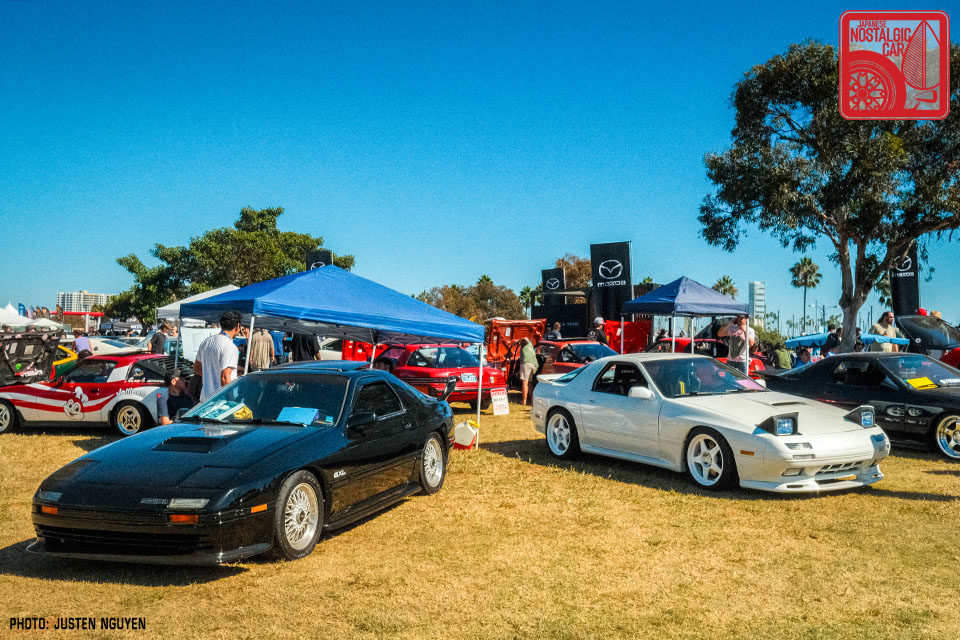
As the years have progressed, the 25-year limit on imports has moved up, welcoming more and more cars from across the Pacific. Nissan Skyline GT-Rs, Toyota Centurys, Mitsubishi Delicas, and all sorts of oddball kei cars have made their way to the Marina Green lawn.
Perhaps even more impressive are the many different types of cars that have emerged are impressive as well. Today there are well-restored 4x4s and pickups, vans, VIP sedans, bosozoku-style kaido racers, vintage race cars, and even Japanese emergency vehicles.
After a few years the big OEMs joined. Toyota, Honda, Mazda, and Nissan put up official booths at JCCS. In 2012, the show expanded to include a show-within-a-show sub-gathering of vintage motorcycles, dubbed the Japanese Classic Motorcycle Show. In 2014 it outgrew the space at Queen Mary Park and the show moved to nearby Marina Green Park in Long Beach, where it’s still held today.
These days, a typical JCCS has 500 cars, and many more that get turned away. There simply isn’t space, and the standards have gotten higher. Each event attracts over 10,000 attendees, with crowds so dense it makes photographing all the cars impossible.
Call us biased, but we think it’s one of the must-see shows in the country. Few events can attract as diverse a field of cars. Every year you’re pretty much guaranteed to see something you’ve never encountered before, whether it’s a Japanese-market find that was never sold in the US, or some long-forgotten rarity of which only a handful of examples remain.
In 2025 few still doubt the classic status of Japanese cars. It’s an incredible testament to the Yamaguchis and what they’ve built. Japanese classics have come a long way, and we hope there will be many more Japanese Classic Car Shows to come.
Additional Images (Special thanks to Justen Nguyen):