Daihatsu Charade, Flying Feather, Nissan-Diesel Minsei inducted into Japan Automotive Hall of Fame

Each year the Japanese Automotive Hall of Fame inducts a selection of historic cars. Past examples have included iconic sports cars like the Toyota 2000GT and S30 Nissan Fairlady Z, or race cars like the Honda RA272 and Mazda 787B. For 2025, the inductees were quite a bit more obscure. We missed this story when the inductees were announced in November, but though these vehicles aren’t on the tips of most tongues they’re still worth a mention.

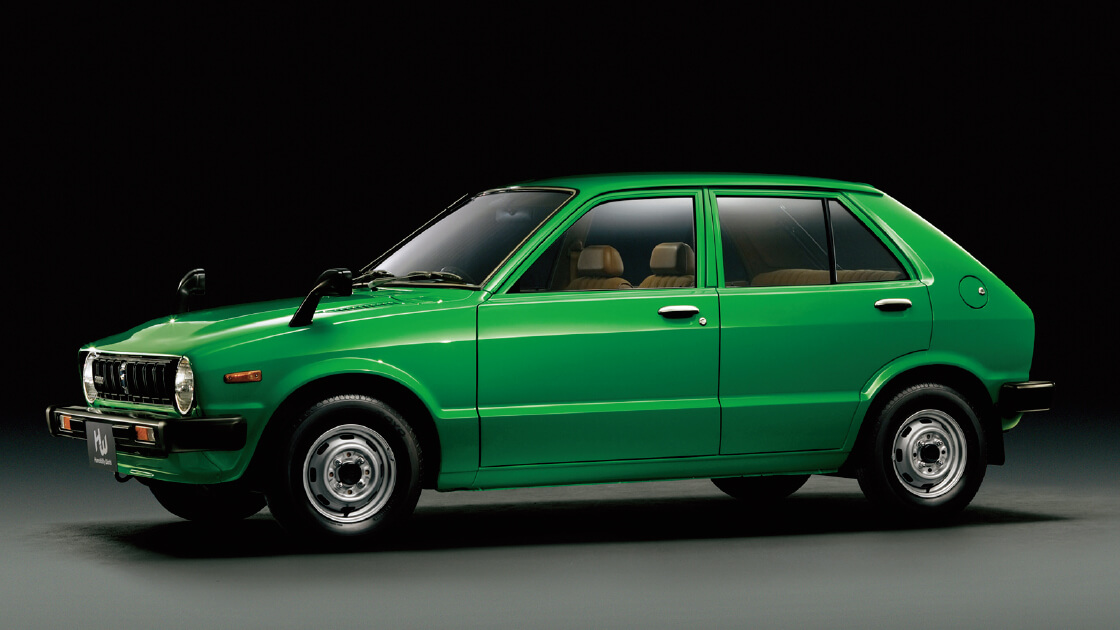
In the wake of the post-oil crisis fuel-conscious 70s, Daihatsu introduced the Charade on October 4, 1977 at the Tokyo Motor Show. It went on sale November 1 of that year equipped with a 993cc engine, the world’s first mass-produced four-stroke 3-cylinder. The compact five-door offered 1300cc-class performance with the fuel economy of a kei car, thanks in part to a 1390- to 1455-pound curb weight depending on trim.

It was praised for its packaging and spaciousness despite a small footprint and won MotorFan magazine’s Car of the Year. But perhaps the Charade’s greatest achievement came during the 1982 Safari Rally, where it took first place in the under 1.0 liter class. It was one of only 21 cars that completed the 3,112 off-road miles, out of 73 cars that started the race, earning it the nickname “Little Giant Killer”.

These days, three-cylinder engines are more popular than ever. Most kei jidosha and even high-performance cars like the Toyota GR Yaris are banging on three pistons. The Daihatsu Charade was a pioneer of three-cylinder motoring and is thus a notable historic model.

The 1954 Suminoe Flying Feather was a lightweight two-seat roadster born at a time when Japan’s auto industry, in a focus on mobility during post-war reconstruction, was making almost exclusively trucks and sedans. The Flying Feather was the brainchild of former Nissan engineer Ryuichi Tomiya, but Nissan’s production capacity at the time was centered on practical saloons like the Bluebird and Cedric. It was Nissan’s Yutaka Katayama, a champion of sports cars and racing, who would later become known as Mr K, that encouraged Tomiya to pursue the idea with Suminoe, Nissan supplier.

The resulting car had a ladder frame with x-members and four-wheel independent suspension. A rear-mounted 12.5-horsepower 350cc engine drove the rear wheels, which were essentially borrowed from a motorcycle and had wire-actuated brakes. It boasted rack-and-pinion steering and a weight of just 937 pounds.

At the time the Japanese government was considering a “people’s car” and the Flying Feather was viewed as a test case. It was built with the bare minimum of materials but engineered to be fun to drive at a time when resources were scarce. Only about 200 were made before discontinuation. It’s arguably a precursor to the kei car, though it wasn’t a commercial success, and the concept was ahead of its time.

Launched in February 1958, the Minsei 6TW was Japan’s first truck with a 10.5-ton capacity. It was a time of rapid reconstruction, with many large-scale infrastructure projects like bridges, dams, and railways under development. Powered by a supercharged 230-horsepower, 651-pound-foot, 7.4-liter 6-cylinder diesel, the 6×4 twin-axle-drive truck could travel at 90 kph (56 mph).

That was faster than 4- and 5-ton trucks at the time, and with a 11-ton capacity variant released in June 1960, it was Japan’s only high-speed heavy-duty truck until 1964. It arrived at a pivotal time, when the rapid and long-distance transport of goods and materials was crucial to the nation’s development.

In addition to the historic vehicles, the JAHoF also inducted Osami Suzuki, CEO of Sanei Shobo, publisher of many Japanese car magazines. Under Suzuki, launched titles like Car Styling, MotoRider, Genroq, Option and Option 2.

Suzuki is most known for his work with MotorFan. With features like MotorFan‘s Car of the Year award and road tests that incorporated the assistance of labs at top universities to measure performance, handling, ride comfort and noise, Suzuki helped push the Japanese car industry to world-class standards.

Rounding out the accolades are a few modern selections. The JAHoF chose as its own Car of the Year the Honda N-One e:, an electric kei car with some retro style inspired by the 1967 Honda N360. The Volkswagen ID.Buzz received the Import Car of the Year award. The Subaru Forester received Technology of the Year for its external airbag to protect cyclists. And finally, the sixth-gen Honda Prelude was presented with the Design of the Year award.


permalink.
This post is filed under: News.

Leave a Reply

Your email address will not be published. Required fields are marked *